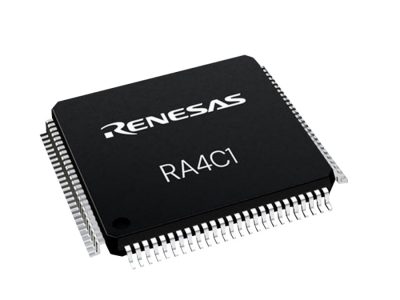
The new RA4C1 series MCUs from Renesas, based on an Arm® Cortex®-M33 core running at up to 80MHz, provide a combination of advanced cybersecurity protection features, a wide range of analogue peripherals and low power consumption.
The RA4C1’s security feature set is particularly well suited to the needs of smart utility meters, which often implement the DLMS/COSEM security framework for data encryption and authentication, and require strong protection against tampering.
The security capabilities of the RA4C1 are based on an isolated security sub-system. This sub-system includes an Arm TrustZone® trusted execution environment and a hardware cryptographic engine. It supports AES-128 and -256 encryption and ECC with up to 384-bit curves in hardware, as well as SHA-224/-256 hashing. A built-in true random number generator and 128-bit unique ID support secure key generation and device authentication.
The RA4C1 MCUs also provide active tamper detection, with three input pins and secure I/O handling which can detect and respond to physical tampering events.
Other characteristics of these new MCUs which will appeal to metering system designers include:
512kbyte dual-bank on-chip Flash memory which enables easy and secure software updates
96kbytes of SRAM for fast data processing
8kbytes of data Flash which can emulate EEPROM for logging consumption data or storing calibration constants
Low-power ADC
On-chip temperature sensor offering 1% accuracy
On-chip LCD controller to drive low-power segment displays
The devices’ low-power features include 168µA/MHz active current, 1.73µA standby current and a maximum 3.5µs wake-up time, to provide for long operating intervals on battery power. A real-time clock has its own dedicated power domain, which means that a meter’s timekeeping can remain active on a coin cell when the main system sleeps.
The RA4C1 MCUs are supported by Renesas’ Flexible Software Package (FSP). The FSP enables faster application development by providing all the infrastructure software needed, including multiple RTOS, BSP, peripheral drivers, middleware, connectivity, networking, as well as reference software. The FSP eases migration of existing IP to and from either RA6 or RA2 Series devices.
The RA4C1 MCUs are available in 64-pin LQFP package measuring 10mm x 10mm, or a 100-pin LQFP package measuring 14mm x 14mm.
Features
Supply-voltage range: 1.6V to 3.6V
Serial interfaces:
SCI
IrDA
I2C
UART
SPI
Quad SPI supporting execute-in-place
CANFD
32-bit and 16-bit timers
32-bit ultra-low power timers
Two watchdog timers
8 x 44 segment LCD drive
Applications
Smart electricity/water/gas meters
Industrial sensing and control nodes
HVAC and building automation controllers
IoT gateways and communications modules
Security equipment
Evaluation Board
Part supported: RA4C1 Series Microcontrollers
Board part number: EK-RA4C1
The EK-RA4C1 enables quick evaluation of the Renesas RA4C1 microcontrollers. The kit provides MCU current measurement points, on-board SEGGER J-Link debugging, 32Mbytes of Octo-SPI Flash, a CAN FD interface, and popular expansion options including Arduino Uno R3, Digilent Pmod and mikroBUS interfaces.
A quick-start demo is pre-loaded to showcase key functions immediately after unboxing, and example projects are available from Renesas to accelerate prototyping.